
Why Your Business Website Needs to Be Optimised for AI Search, Not Just Google
***Disclaimer: ***This is general information for business owners thinking about AI search and website visibility, not technical, legal, or financial advice. The 2026 figures here are directional, not precise, and this area moves fast, so confirm the current detail before acting. Treat it as a starting point, not a guarantee of results. Synivo builds websites and runs digital marketing, and is upfront about where its services fit.
Ask yourself one thing. Last time you needed a plumber, a supplier, or an accountant, did you scroll a page of blue links, or type the question into an AI assistant and read what it wrote back?
More of your customers now do the second thing, which is the whole reason AI search optimization for business suddenly matters. They ask, they read what the AI says, they act, and often no results page comes into it at all. Here is the sting: if that answer never names you, you were never in the running. Nobody picked a rival over you; they just never learned you existed.
This shift is running underneath every industry now, and most owners have not caught up. AI search optimization for business is no longer a nice to have for the tech savvy. It is fast becoming the line between being found and being invisible.
Almost everything on this is written by marketers, for marketers, dense with jargon. This is the opposite: the plain version, for the owner who wants two answers, does this affect me, and what do I change on my site?
Let us dig in.
First, what is actually happening to search?
For twenty years, being found online meant one thing: ranking on page one. Those top blue links were where the clicks lived, and a whole industry grew up chasing them.
That world is not gone, but it is no longer the whole picture.
Two things shifted at once. First, the search engines started answering questions themselves, a generated summary parked above the old blue links. Plenty of searches end right there, read and done, nobody clicking through. That is a zero click search, and most searches now land in that camp.
Second, and bigger, a new front door opened. Many people now skip the search engine and start with a conversational AI assistant, asking in plain English and getting a tailored answer from sources it trusts. One popular assistant hit around 900 million weekly users in early 2026; another fields hundreds of millions of questions a month. That is where a growing slice of your customers now start.
So the question is no longer just "do I rank on the search engines." It is also "when someone asks an AI about what I do, does my business get named in the answer?" Two different games, and most businesses only play the first.
GEO, AEO, and the alphabet soup, explained simply
You will meet a few new acronyms here, and the jargon scares owners off before they start. Let us clear it plainly, because the ideas underneath are simple.
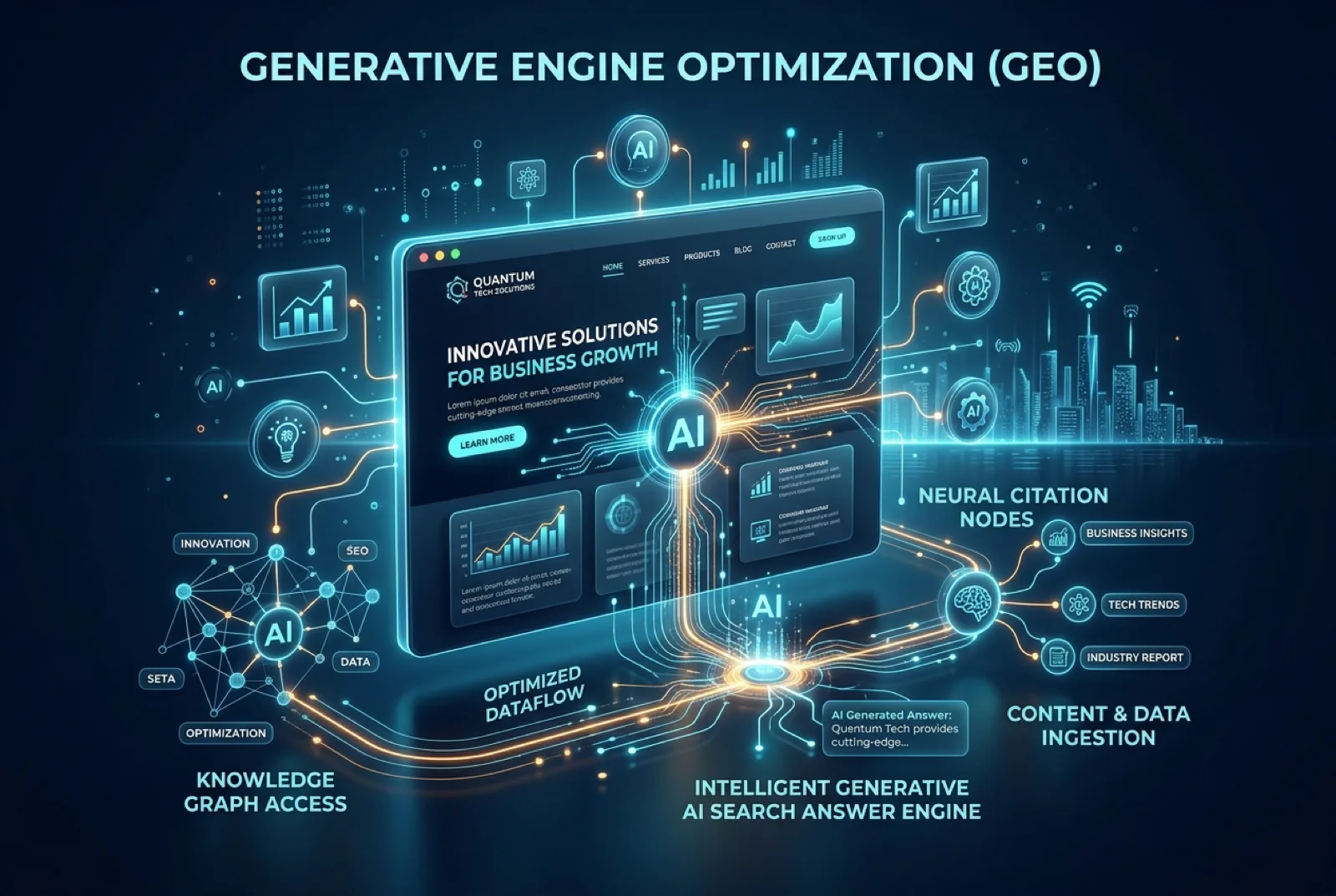
Generative Engine Optimization (GEO) means structuring your website content so AI engines cite it as a source when they write their answers. Old optimisation chased a ranking; this chases a mention inside the answer itself.
Answer Engine Optimization (AEO) is its close sibling, near interchangeable, leaning a little more toward being the direct answer to a question, the kind that fills a featured snippet or gets read aloud by a voice assistant.
Do not lose sleep over the distinction. For a business owner, GEO and AEO chase the same thing: being the source the AI reaches for. Old optimisation asked how to rank higher in the list; these ask how to become the answer itself.
And to answer the anxious question everyone has: your existing SEO was not wasted. The finish line just moved. Ranking still helps; it is simply no longer the whole job.
Is SEO dead because of AI search?
Short answer: no. But ranking only strategies are quietly leaving money on the table, and the gap is widening.
The honest picture: traditional SEO still matters, because AI engines and search engines lean on a lot of the same signals, and a site invisible to normal search tends to be invisible to AI too. The foundation still counts.
What changed is that a good ranking no longer guarantees anything. You can top the blue links and still be absent from the AI answer printed above them, which is the bit more people actually read. Ranking gets you into the library; it does not make the AI quote your book.
So SEO is not dead. It has just been demoted from the whole strategy to the entry ticket. The businesses pulling ahead treat strong fundamentals as the base, then do the extra work to get cited in AI answers on top. The ones standing still still think a page one ranking is job done.
AI search vs Google search: two different kinds of visibility
It helps to see these side by side, because they reward different things, and owners often assume winning one wins the other. It does not always.
| Traditional search visibility | AI answer visibility | |
|---|---|---|
| What you compete for | A high ranking position in a list of links | A mention or citation inside a generated answer |
| What the customer sees | A page of blue links to choose from | A single written answer, often naming a few businesses |
| What it rewards | Keywords, backlinks, page authority, ranking signals | Clear direct answers, structured data, consistent entity information, trusted third party mentions |
| The customer journey | Search, scan the list, click through to sites | Ask, read the answer, act on who the AI named |
| How you win | Rank above competitors for the search term | Become the source the AI trusts enough to cite |
The bottom row is the takeaway. Traditional search is about beating rivals to the top of a list; AI visibility is about being clear and trustworthy enough that the AI quotes you. Related skills, not the same one, and the second is the open ground right now.
How AI engines actually decide what to cite
This part is worth understanding, because once you see how the decision gets made, the checklist later writes itself.
An AI answer engine, run underneath by a Large Language Model (LLM), does not rank pages the old way. Ask it something and it builds an answer from sources it reckons clear, credible and consistent. Earning an LLM citation of your page is the real prize now, so it helps to know what tips a business onto that trusted list.
The first is direct, answer shaped content. AI engines favour content that answers a real question plainly and up front, not buried under three paragraphs. "A standard call out fee here is X, and here is what it covers" beats a page that waffles toward the point.
The second is structured data, or schema markup: code behind your site that spells out in machine readable form what your business is, what it does, where it works, and what each page covers. People never see it. AI engines and crawlers lean on it hard, because it removes the guesswork.
The third is entity authority and consistency. The AI wants proof you are who you claim, so it cross checks your details across your site and the wider web. If your name, address and description read one way on your site and another on the big third party platforms, that mismatch drains trust. Line them up and it builds.
The fourth is the long standing quality bar the search world sums up as Experience, Expertise, Authoritativeness and Trustworthiness. Nothing new; the same standard as ever, and AI leans on the same signals: real expertise, cited facts, a business that clearly knows its trade.
Underpinning all of it is crawlability. If the bots that feed these AI engines cannot read your site cleanly, none of the rest counts; you are not even in the pool. A fast, sound, readable site is the price of entry.
Notice the through line. Most of what earns an AI citation comes back to two things: your own first party website content, and your footprint on the major third party platforms. Not backlink tricks or keyword stuffing, just clear, consistent, credible information machines can read.
Why this matters for revenue, not just visibility
It would be easy to file this under "marketing to worry about later." Mistake. Here is the number that shows why.
Across several 2026 studies, visitors arriving from an AI answer engine convert at meaningfully higher rates than those from traditional search. It makes sense: someone who clicks through after an AI has described you, vouched for you, and answered their first questions arrives pre warmed. A chunk of the selling is already done before they reach your page.
On top of that, AI referral traffic, the visitors these answer platforms send on to outside websites, has grown several fold year over year. So this is not a small trickle of curious visitors. It is a fast growing channel, and the people it sends tend to be closer to buying.
Put those together and it is clear. AI search sends not just more people but better ones, closer to buying. A business invisible to AI engines is not missing vanity traffic; it is handing its most ready to buy visitors straight to whoever the AI named.
The AI search optimisation checklist for business owners
Here is where theory turns into something you can do. Run your site through these, in order, and you are already ahead of most of your market.
- Answer real questions directly on your site. List what customers actually ask, and answer each plainly, direct answer first, no preamble. The highest impact move most businesses can make, and it costs nothing but time.
- Add structured data markup. Get schema onto your key pages so AI engines and crawlers can read exactly what your business is and does. A developer task, usually quick, and one of the clearest signals you can send.
- Make your business details identical everywhere. Name, address, phone and core description should match exactly across your site and every major third party review and listing platform. Mismatches quietly erode the trust these engines look for.
- Cite real facts, not vague claims. "We are the best in the business" is invisible to an AI. "A typical project here runs X and takes Y weeks" is quotable. Concrete, specific, sourced content gets cited; marketing fluff gets skipped.
- Keep your site fast and readable for bots. If crawlers cannot reach and parse your pages, nothing else here counts. Clean, quick, sound pages are the foundation the rest sits on.
- Publish in the language people actually ask in. People type conversational, long question style searches into AI tools, not clipped keywords. Content written the way real people phrase things matches those conversational long tail queries far better. Work down that list and you cover both halves: content that is clear and quotable, and a site that is readable and consistent. Most businesses do neither yet, which is exactly why the window is open.
The catch: this needs both halves, and most providers only do one
Here is the practical snag that trips businesses up, worth naming plainly.
Look back at that checklist. Half is content work: clear answers, real facts, phrasing things the way customers ask. Half is technical: schema markup, crawlability, a fast clean site. Getting cited needs both, working together.
Trouble is, most providers only do one. A marketing agency writes lovely answer style content but cannot touch the schema or site speed beneath it. A developer builds a fast, cleanly marked up site but will not write the answers that get quoted. So you juggle two suppliers pointing at each other, and the halves never quite join.
Close that gap before you start, because AI visibility falls apart when the content and the technical work sit with people who never talk to each other.
Where Synivo fits
Upfront about who is writing this: Synivo is a Brisbane based web, AI, and digital marketing studio, and getting Australian businesses found in AI search is exactly what we do.
This topic sits naturally with us because of that catch above. We do both halves under one roof: we build the site, so the structured data, crawlability and performance are handled in the code, and we run the content side, so the clear direct answers that get quoted are written too. No stitching a developer to a marketer and hoping they cooperate. One team, both halves.
There is a real early mover advantage too. The shift is new enough that most competitors have done nothing yet. Act now, while the field is thin, and you are the source AI engines already trust by the time everyone else wakes up.
Not sure whether your business shows up when someone asks an AI about what you do? That is the first thing worth checking, and it is easy to find out. See what we do at synivo.tech, or book a free discovery call for a straight, plain language read on where you stand and the few highest impact fixes to make first. No jargon, no pressure.
Questions business owners ask us
Do I need to optimise my website for AI search, not just Google?
Yes. One leading AI assistant alone reaches roughly 900 million weekly users, and AI answer engines increasingly give direct answers instead of sending a click to a results page. A website invisible to AI engines is invisible to a fast growing share of buyers who research through AI before they ever visit.
What is generative engine optimization (GEO)?
Generative Engine Optimization means structuring your website content so AI engines cite it as a source when they generate answers, rather than optimising purely to rank in traditional search. It is about becoming the trusted source an AI quotes, through clear answers, structured data, and consistent business information.
How do AI search engines decide what to cite?
AI engines favour content with clear direct answers, cited statistics, structured data markup, and consistent entity information across a business’s own website and third party listing or review platforms. Backlink volume alone does not drive it. They cite sources that are clear, credible, machine readable, and consistent about who the business is.
Is traditional SEO becoming less important because of AI search?
Not less important, but no longer sufficient alone. A majority of searches already end without a click, and ranking well in the blue links does not guarantee a citation inside an AI generated answer, which now captures a growing share of buyer attention. SEO is the foundation; AI visibility the new layer on top.
What is the difference between SEO, AEO, and GEO?
SEO optimises for ranking in traditional search results. Answer Engine Optimization and Generative Engine Optimization optimise for being cited directly inside an AI generated answer, whether a featured snippet, a voice assistant reply, or a chatbot response, rather than a click through ranking. They target the answer, not the list.
How can a small business get its website mentioned in AI answers?
Publish clear, direct answers to the questions customers actually ask, add structured data markup to key pages, keep your business information identical across your website and major listing platforms, and cite real statistics rather than vague marketing claims. Together these make your site clear and trustworthy enough to quote.