
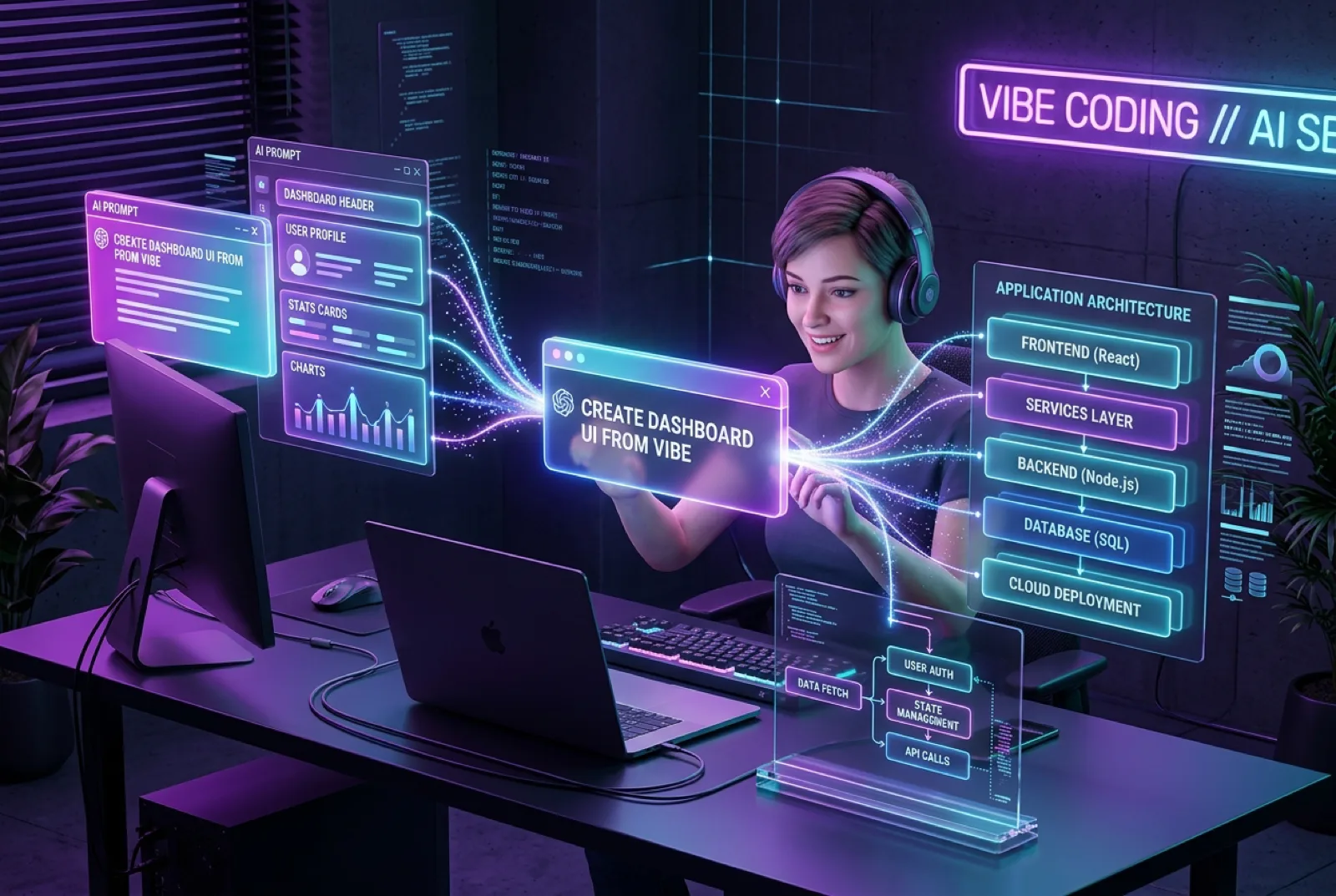
Vibe Coding Is Here: What It Means for Businesses That Need Custom Software
***Disclaimer: ***This is general information for business owners weighing AI assisted software building, not technical, legal, or security advice. The figures here come from 2026 industry reporting and are directional rather than precise; confirm the current detail for your situation before acting. Synivo builds custom software and is upfront about where its services fit.
A year ago, building an app meant hiring developers. Today a founder with an idea and an AI tool can have something working by the weekend. That shift has a name now, and it is everywhere: vibe coding.
If you run a business and you have watched someone spin up a working prototype in an afternoon, you have probably asked the obvious question. Is this enough? Can I just build the thing myself and skip the development cost entirely?
The honest answer is: sometimes yes, and sometimes it is the most expensive shortcut you will ever take. Which one depends on what your software actually has to do.
Most writing on vibe coding sits at one of two extremes. There is the breathless hype from the tool makers, and there is the dense, statistics heavy warning aimed at engineers. Almost nobody has written the plain version for the person actually making the call: a business owner without a technical background trying to decide whether AI assisted building is enough, or whether it is time to bring in a real development partner.
This is that version. What vibe coding actually is, where it genuinely shines, where it quietly bites, and a clear set of triggers for knowing when you have outgrown it.
Let's get into it.
What is vibe coding?
Vibe coding is building software mostly by describing what you want, in plain language, to an AI tool, then accepting the code it generates with little or no manual review.
You type "build me a booking form that emails the customer and saves their details," and working code appears. No writing it line by line, no computer science degree required. You steer by feel, by the vibe of whether the thing seems to work, rather than by reading and understanding every line underneath.
That is the appeal, and it is a real one. What used to take a developer days can take minutes. For getting an idea out of your head and onto a screen, nothing has ever been faster.
The catch is hidden in that phrase "little or no manual review." Speed comes from skipping the slow, unglamorous parts of proper software building: the planning, the testing, the security checks, the architecture that lets a thing grow. Skip those and you move fast. Whether that matters depends entirely on what you are building.
Why vibe coding is having its moment
This is not a fringe experiment. It has gone mainstream at genuine speed.
A large share of early stage startups now ship the first version of their product, the minimum viable product or MVP, with a substantial amount of AI generated code. For a founder racing to prove an idea before the money runs out, that makes complete sense. At the startup MVP validation stage, speed to a working prototype is the whole game, and vibe coding delivers it like nothing before.
So let us be clear up front, because a lot of writing on this is sneering: vibe coding is not a scam or a fad. For the right job it is a legitimate, genuinely useful way to start. The problem is never the starting. The problem is not knowing when the starting phase is over.
Which is exactly what the rest of this guide is about.
Vibe coding vs custom software development: the real difference
People treat these as two names for the same thing. They are not, and the gap between them is where most of the trouble lives.
Here is the plain distinction:
- Vibe coding generates working code fast from plain language prompts, optimised for speed over structure. Brilliant for proving an idea exists.
- Custom software development adds the parts you cannot see: requirements planning, testing, a security review, and a maintainable, scalable software architecture built to grow. Slower to start, built to last. The trap is that both look identical on day one. The prototype runs. The demo works. Everyone is happy. The difference does not show up at launch; it shows up three months later, when you try to add a feature, handle more users, or pass a security check, and the whole thing starts to groan.
Think of it like the difference between a film set and a real building. From the front, the film set looks like a house. It photographs beautifully. But there is nothing behind the facade, no foundations, no plumbing, no wiring, and the moment you try to actually live in it, that becomes very clear. Vibe coding is superb at building the film set. Custom development builds the house.
Is vibe coding safe for business?
This is the question that actually matters, and it deserves a straight answer rather than a scare.
It depends entirely on what the software touches.
For an internal tool, a quick calculator, a rough prototype you are showing three people, vibe coding is a perfectly reasonable starting point. If it breaks, nobody gets hurt and no data leaks. Build away.
The picture changes the moment real people and real data are involved. Independent 2026 security scans of production AI generated codebases found that a majority carried at least one traceable security vulnerability. The reason is simple: unless a developer explicitly directs it to, AI generated code frequently skips the boring, essential safety work, proper error handling, access controls, and data validation.
So the honest rule of thumb is this. If your software handles payment details, customer records, or anything with data security and compliance requirements attached, unreviewed vibe coding is a genuine risk, not a theoretical one. That kind of workflow needs a security reviewed, properly tested build underneath it, not a prototype you are hoping holds.
The hidden cost: what happens 60 to 90 days in
Here is the part almost nobody warns you about, because it does not show up in the exciting first week.
There is a pattern the industry has started to recognise: a reckoning point that tends to land around 60 to 90 days into a vibe coded project. The early speed was intoxicating, then somewhere around the two to three month mark, progress grinds. Bugs keep reappearing. Nobody, including the AI, can fully explain why the code does what it does. More and more of your time goes into fixing rather than building.
There is a name for what has quietly piled up: technical debt. It is the future cost of choosing the fast option now, and clearing it is a discipline of its own, the same rescue engineering and legacy modernisation work that ageing systems eventually demand. In AI assisted codebases it has been tracked climbing sharply after adoption, with duplicated code multiplying and the tidying up work that keeps software healthy falling away.
The numbers around fixing it are sobering. Rescue engineering, the work of rebuilding a failing AI generated app into something stable, typically costs several times the original build budget. That is because someone has to reverse engineer undocumented logic and unpick duplicated code before they can safely add anything new. You do not just pay to build it twice. You pay a premium to untangle the first version first.
Analysts expect most technology decision makers to be managing moderate to severe technical debt by the end of 2026. If you are building this way, you are not an exception to that trend. You are the trend.
When to move beyond vibe coding: the graduation checklist
This is the framework the internet is strangely missing. Not a vague "be careful," but a concrete list of triggers. If your project hits any of these, it has graduated, and it is time to bring engineering discipline in behind it.
| Trigger | Why it matters | What it needs instead |
|---|---|---|
| You are handling payment or personal data | Sensitive data workflows are where unreviewed AI code fails hardest, on error handling, access control and validation | A security reviewed, tested build with proper data handling |
| You need to integrate with other systems | Third party API integrations are fiddly and break quietly; prototypes rarely handle the edge cases | Engineered integrations with real error handling and monitoring |
| You need to scale past a prototype | Code built for a demo often falls over when real users and real data arrive at volume | A scalable software architecture designed for growth from the start |
| You need to pass a security or compliance review | Investors, enterprise customers and regulators will not sign off on an unreviewed codebase | A formal security vulnerability review and documented, testable code |
| Feature velocity is slowing and bugs keep returning | The classic 60 to 90 day reckoning: fixing is eating the time you used to spend building | Refactoring, proper code review and QA governance to stop the bleeding |
You do not need all five. Any one of them is the signal. The mistake is not starting with vibe coding; it is carrying on with it past the point where one of these has clearly landed.
So what should your business actually do?
Here is the honest middle path, the one the hype and the fear both skip.
Vibe coding and custom development are not enemies, and you do not have to pick a side for life. They are two stages of the same journey. The smart play is to use each for what it is genuinely good at.
Use fast AI assisted building to validate the idea. Prove people want the thing before you spend real money engineering it. This is where the no code and low code AI builders, and vibe coding generally, earn their keep: cheap, fast proof that the concept has legs.
Then, once it works and the triggers above start appearing, bring in engineering discipline to build the version that lasts. Not a full rewrite for its own sake, but a deliberate step up: a proper software development life cycle (SDLC), a security review, an architecture that scales. Build fast to learn, then build properly to grow.
That progression, prototype to production grade software, is not a failure of the first stage. It is the natural success of it. The prototype did its job. Now the real thing gets built.
Where Synivo fits
We will be upfront about who is writing this. Synivo is a Brisbane based software and AI development studio, and helping businesses make exactly this call, and then building the production version when they are ready, is squarely what we do.
That shapes how we see vibe coding, and it is why this guide is neither hype nor doom. Our own process already pairs rapid prototyping with real engineering discipline, so we can say honestly that starting fast is fine. We just build the thing properly once it matters.
If you have a prototype that is gaining traction, or you have hit that 60 to 90 day wall where the bugs will not stop, that is the moment worth a conversation. We can tell you plainly whether your build is fine as is, needs a security review, or is ready to graduate to something engineered to scale.
Have a look at what we do at synivo.tech, or book a free discovery call for a straight, plain language read on where your software actually stands. No jargon, no sales pressure.
Questions business owners ask us
Is vibe coding safe for a business to rely on?
It depends on what the software handles. For an internal tool or early prototype, it can be a reasonable starting point. For anything touching payment data, customer records, or compliance requirements, independent 2026 security scans found most unreviewed AI generated codebases carried at least one traceable vulnerability, so a reviewed build is safer.
What is the difference between vibe coding and custom software development?
Vibe coding uses AI prompts to generate working code quickly, optimised for speed over architecture. Custom software development adds requirements planning, testing, security review, and a maintainable architecture designed to scale. The difference shows up after launch, not before it, when you try to grow, integrate, or secure the thing.
When should a business move from vibe coding to a custom development team?
Common triggers: the product needs to handle payment or personal data, integrate with other systems, support more users than a single prototype can manage, or pass a security or compliance review before a customer or investor will sign off. Any one of these is the signal to bring in engineering.
How much does it cost to fix a vibe coded app?
Rescue or rebuild engineering for a failing AI generated codebase typically costs several times the original build budget. The work involves untangling undocumented logic and duplicated code before new features can be added safely, so you pay a premium to unpick the first version before the stable one can be built.
Can vibe coding handle sensitive business data like payments or customer records?
Not safely without review. AI generated code frequently skips proper error handling, access controls, and data validation unless a developer explicitly directs it to. Sensitive data workflows need a security reviewed, tested build rather than an unreviewed AI generated one, because the cost of a leak far outweighs the time saved.