
Your dashboards are only as smart as the pipeline feeding them. And most pipelines are held together by spreadsheets, cron jobs, and prayer.
The Real Reason "Data-Driven" Companies Still Guess
Almost every business we talk to says the same thing: "We have tons of data. We just can't use it." That isn't a data problem. It's a pipeline problem.
Sales data lives in HubSpot. Finance in QuickBooks. Operations in three different spreadsheets. Customer behaviour in Mixpanel. Inventory in an ERP nobody likes. Each system tells a story - but none of them talk to each other.
Without a pipeline, your "data strategy" is really just manual exports, midnight CSV emails, and dashboards built on assumptions that were true last quarter. A custom data pipeline fixes that. An AI-powered one goes further - it doesn't just move data, it understands it.
What a Data Pipeline Actually Is (Without the Jargon)
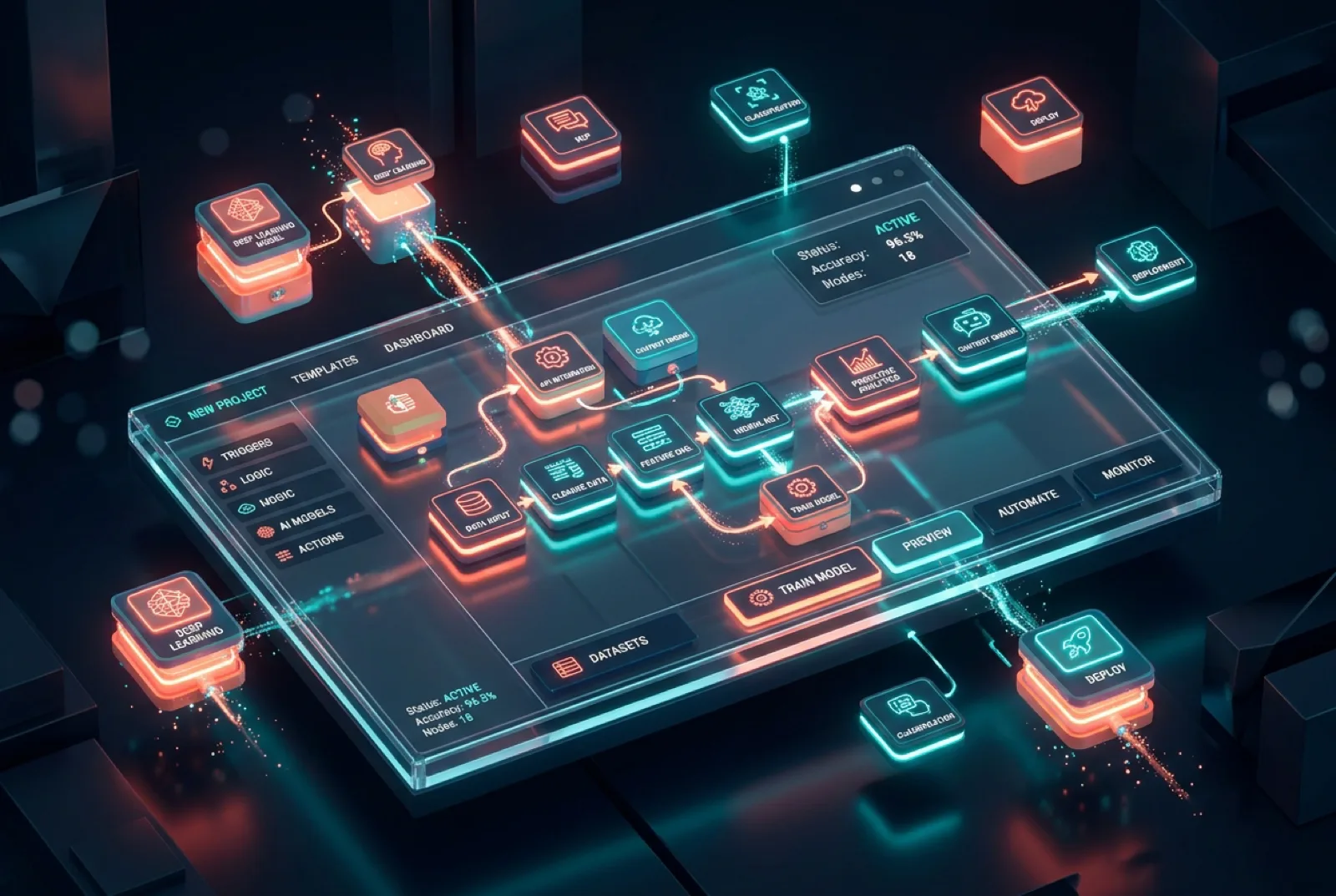
A data pipeline is the plumbing that moves information from where it's generated to where it's useful. Think of it as a delivery system with four jobs: Sources (CRM, ERP, apps, spreadsheets, IoT, APIs, web events) feed into Ingest & Clean (collect, validate, dedupe, standardise), which feeds Transform & Enrich (join, model, apply AI / ML enrichment), which finally feeds Delivery (dashboards, AI agents, reports, automations, product features).
When done right, you stop asking "where is that number?" and start asking "what should we do with it?"
Why "AI Data Pipelines" Are Different From Traditional ETL
The old ETL playbook - extract, transform, load - was built for a world where data was tidy, slow, and structured. That world is gone. Modern businesses generate unstructured text (emails, tickets, reviews, transcripts), semi-structured logs, streaming signals, and multi-modal data like images, audio, and PDFs. Traditional pipelines choke on this. An AI data pipeline is purpose-built for it:
| Traditional ETL | AI-Powered Data Pipeline |
|---|---|
| Moves rows between databases | Moves meaning between systems |
| Breaks on schema changes | Adapts to schema drift automatically |
| Structured data only | Handles text, images, audio, PDFs |
| Batch (hours / days) | Real-time + batch hybrid |
| Hard-coded business rules | LLM + ML enrichment in-flight |
| Human writes every transform | AI suggests and validates transforms |
| Output: rows in a warehouse | Output: rows, embeddings, summaries, alerts, agents |
This is the shift: pipelines aren't just plumbing anymore - they're the runtime layer for AI in your business.
What a Modern Custom AI Data Pipeline Looks Like
Here's the architecture we typically build for clients - adapted to their stack, but consistent in principle. It runs as five connected layers:
- Data Sources - CRM / sales, ERP / finance, product events, support tickets, documents and PDFs, external APIs.
- Ingestion Layer - connectors (Fivetran, Airbyte, custom APIs) for batch sources, plus an event stream (Kafka, Kinesis) for high-volume telemetry.
- Storage - a data lake (S3, GCS) for raw data, a warehouse (BigQuery, Snowflake) for modeled data, and a vector DB (Pinecone, pgvector) for embeddings.
- Transform + AI Layer - dbt / SQL models for business logic, LLM enrichment for summarising / classifying / extracting from unstructured inputs, and ML models for scoring and forecasting.
- Delivery - BI dashboards, AI agents and chat interfaces, automations (Slack, email, CRM updates), and embedded product features.
The critical detail: the transform layer has two outputs - structured rows for dashboards and embeddings + summaries for AI agents. This dual-output design is what makes a pipeline truly "AI-ready": the same source data powers your CFO's report and the LLM that answers a customer's question in chat.
The Five Stages We Build (And What Each Solves)
1. Ingestion - Stop the Bleeding First
Most data problems start here. Exports get forgotten, APIs change silently, someone resigns and a critical Zapier breaks. We build ingestion layers that are connector-first for standard SaaS, API-native for proprietary systems, event-driven for high-volume telemetry, and schema-aware so changes upstream don't quietly break dashboards downstream.
Outcome: Every relevant data point lands in one place, automatically, within minutes of being generated.
2. Storage - Build a Layered Foundation
Dumping everything into one database is how pipelines collapse under their own weight. We use a four-layer model: a Raw Layer (unchanged source data, immutable and auditable), a Staging Layer (cleaned, deduped, type-cast, validated), a Modeled Layer (business entities - customers, orders, sessions, revenue), and a Serving Layer (dashboards, APIs, AI context windows).
Each layer has one job. When something breaks, you know exactly where to look. When a new business question shows up, you know exactly where to build.
3. Transformation + AI Enrichment - Where the Real Value Lives
This is the part traditional ETL got wrong. Moving data is easy; making data mean something is the hard part. In an AI data pipeline, the transform layer doesn't just join tables - it classifies free-text inputs, extracts structured fields from PDFs and contracts, summarises long-form content, scores records with ML (lead quality, churn risk, fraud), and embeds text and documents into vectors for semantic search and AI agents.
A real example from a recent build: 40,000 unstructured support tickets became a structured table of (category, sentiment, root cause, suggested action, similar past tickets) - all derived in-pipeline by an LLM, then validated against rules before landing in the warehouse. That table powered a dashboard and a customer-facing AI agent. Same pipeline. Two products.
4. Orchestration - The Invisible Reliability Layer
Pipelines fail. APIs go down. Source systems push bad data. The difference between a hobby pipeline and a business-grade one is how it handles failure. We build orchestration with idempotent jobs, dependency-aware scheduling, automatic retries with backoff, data quality tests on every run (row counts, null checks, schema diffs), and alerting that pings the right person on the right channel - not a noisy email no one reads.
Tools we reach for: Airflow, Dagster, Prefect, dbt Cloud. The choice depends on the team's existing stack, not on hype.
5. Delivery - Where Data Becomes Action
A pipeline that ends in a dashboard nobody opens is just expensive plumbing. We design delivery for decisions, not displays - BI dashboards for trends, reverse ETL to push insights back into operational tools (lead scores in your CRM, segments in your email platform, alerts in Slack), AI agents that answer business questions in natural language grounded in your real data, and embedded features so the same pipeline that powers internal reporting can power customer-facing analytics in your product.
When the pipeline is well-designed, every team gets the answer in the tool they already use.
What This Actually Does for a Business (Real Numbers)
Across recent builds, here's the kind of impact we typically see in the first 90 days:
| Metric | Before | After Custom Pipeline | Change |
|---|---|---|---|
| Time to weekly report | 6–8 hours of manual work | Auto-generated | ↓ 100% |
| Data freshness in dashboards | 24–72 hours | Under 5 minutes | ↓ 99% |
| Manual data entry / reconciliation | 12+ hours/week | < 1 hour/week | ↓ 92% |
| "Where is that number?" Slack messages | Daily | Rare | ↓ ~95% |
| Lead scoring lag | Weekly batch | Real-time | Real-time |
| Forecast accuracy | Best-guess | ML-assisted | +20–35% typical |
These aren't theoretical numbers. They're what happens when a business stops fighting its data and starts using it.
Use Cases We Build Custom AI Data Pipelines For
We build pipelines across every function of the business:
| Function | What the Pipeline Powers |
|---|---|
| Sales & Revenue | Real-time lead scoring, pipeline forecasting, churn prediction |
| Operations | Inventory forecasting, demand planning, SLA & quality monitoring |
| Customer Experience | Ticket triage & routing, sentiment tracking, personalised recommendations |
| Finance | Automated reporting, cash flow forecasting, anomaly & fraud detection |
| Product | Usage analytics, feature impact analysis, embedded AI experiences |
| Marketing | Attribution modeling, audience segmentation, content performance AI |
Different industries. Same underlying architecture. The pipeline doesn't care whether you're selling SaaS, running a clinic, managing a logistics fleet, or shipping consumer products - it just needs to know what data you have and what decisions you need to make.
Common Mistakes We Help Businesses Avoid
We've inherited a lot of broken pipelines. Almost all of them died for one of these reasons:
- Built around a tool, not a problem. A pipeline scaffolded entirely around "we bought Snowflake" tends to serve Snowflake, not the business.
- No data contract between teams. Engineering ships a schema change, analytics breaks silently for two weeks.
- No quality tests. Pipelines that don't validate their own output eventually power decisions on garbage.
- AI bolted on at the end. Treating AI as a dashboard widget instead of a first-class output means the pipeline can't actually feed AI agents reliably.
- No owner. A pipeline without a responsible team is debt with a delivery schedule.
A custom build done properly addresses each of these from day one - not as a v2 cleanup later.
How We Build Pipelines at Synivo
Our approach is intentionally unglamorous. No 18-month "data transformation programmes." No buying every tool on the modern data stack landscape diagram. A typical engagement runs in four phases:
- Weeks 1–2 - Audit. Map data sources, identify real decisions the business needs to make, find the quick wins.
- Weeks 3–5 - Ship. First pipeline goes live in production. We deliver real value before getting trapped in architecture debates.
- Weeks 6–10 - Layer AI. LLM enrichment, ML scoring, reverse-ETL flows, and AI agent endpoints get added on top of the working foundation.
- Ongoing - Evolve. Monitor, refine, and extend. The pipeline grows with the business instead of being rebuilt every two years.
We start by identifying the most expensive question your business currently can't answer fast - and we build the pipeline to answer it first. Architecture serves the question, not the other way around.
The Tech We Use (And Why)
We're stack-agnostic, but here's where we land most often: Airbyte / Fivetran / Kafka for ingestion; BigQuery, Snowflake, or Postgres + S3/GCS for storage; dbt and Python for transformation; Dagster, Airflow, or Prefect for orchestration; OpenAI / Anthropic APIs, open-source LLMs where data sensitivity requires, plus scikit-learn / XGBoost and pgvector / Pinecone for the AI/ML layer; and Metabase, Looker, or custom Next.js dashboards for delivery.
The point isn't the logo. The point is that every choice has a reason tied to your business - your team's skills, your data sensitivity, your budget, your scale.
When a Custom Pipeline Makes Sense (And When It Doesn't)
It's the right call when you have data in 3+ disconnected systems and need a single source of truth, your team spends real hours each week building reports manually, you want to deploy AI agents or forecasting that depend on clean business data, off-the-shelf BI tools can't model your business logic, or you need real-time signals rather than yesterday's CSV.
It's probably not the right call if you have one tool and one source of data (start with that tool's built-in analytics first), you haven't identified the decisions data should drive, or you're chasing "AI" as a buzzword instead of a business outcome.
We'll tell you which side of that line you're on - honestly - before we ever quote a build.
Final Thoughts
The companies pulling ahead in 2026 aren't winning because they bought AI. They're winning because their data flows like infrastructure - quietly, reliably, and into every decision that matters. That's what a custom AI data pipeline gives you. Not a dashboard. Not a tool. A nervous system for your business.
Ready to Build a Data Pipeline That Actually Works?
At Synivo Tech, we design and build custom AI data pipelines for businesses that are done duct-taping spreadsheets, exports, and disconnected tools. We handle custom data pipeline development end-to-end, AI & LLM enrichment for unstructured data, real-time and batch data integration, data warehousing & modeling, ML-powered forecasting, scoring, and anomaly detection, and reverse-ETL and AI agent delivery layers.
Start a conversation with us today - or DM us on LinkedIn. We'll show you what a properly-built pipeline could do for your business in the next 90 days.
Keywords: custom data pipeline development, AI data pipeline, build data pipeline for business, data engineering services, ETL pipeline, real-time data integration, machine learning pipeline, data warehouse setup, data pipeline architecture, LLM data enrichment, custom AI solutions, business intelligence pipeline, Synivo Tech