No, we didn't just "add AI." We rethought everything from scratch.
The Question That Started It All
Every business has workflows - those invisible assembly lines that keep things running. Over time, they accumulate patches, workarounds, and duct-tape fixes until nobody remembers why anything works the way it does.
Our client was no different. Their internal workflow had grown into a sprawling, 14-step process that touched five different tools, three teams, and zero logic.
So we didn't ask "How do we improve this?"
We asked something harder:
"If this workflow launched today - with everything available in 2026 - what would it look like?"
The answer was brutal. Almost nothing from the original survived.
The Old Workflow: A Maze Nobody Designed
Here's what their process actually looked like - a tangled chain of handoffs, manual entries, and bottlenecks:
14 steps. 5 tools. 3 teams. Average turnaround: 9 days.
The process wasn't designed - it evolved, like a city built without a map. Every step existed because someone once said "just do it this way for now" and "for now" became forever.
The New Workflow: Streamlined to the Core
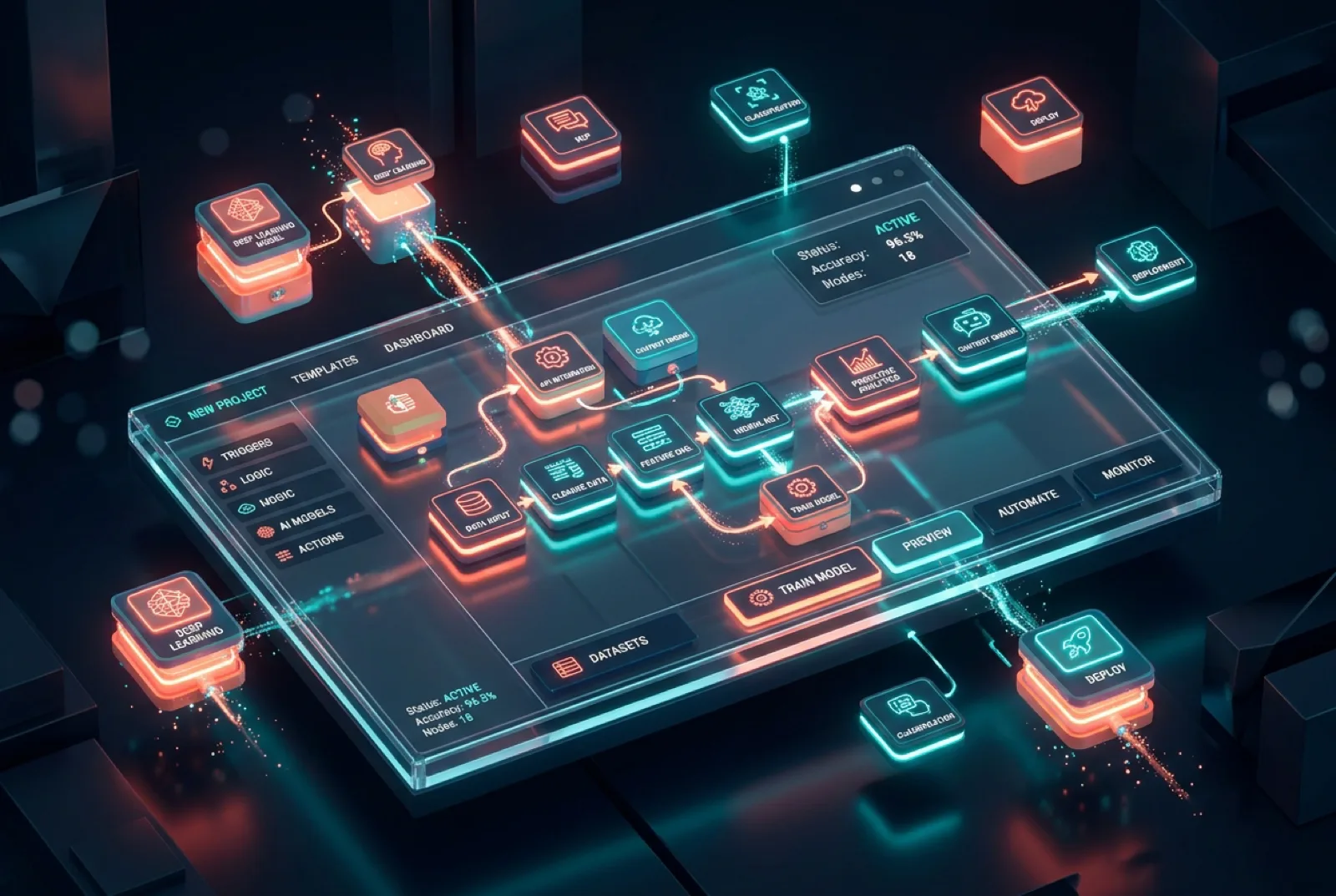
We stripped it down to what actually matters - a unified, intelligent pipeline that runs in a fraction of the time:
4 stages. 1 platform. Average turnaround: under 2 days.
We didn't arrive at this by simply combining steps. We fundamentally rethought what a workflow means when intelligent systems can handle the boring parts.
Breaking Down Each Transformation
1. Request Intake - From Chaos to Clarity
What changed: Requests used to arrive by email. Someone would manually read them, pull out the important bits, and type them into a spreadsheet. Sometimes things got lost. Sometimes they got entered wrong. Always, it took too long.
Now: Requests flow in from any channel - email, web forms, even Slack messages. An AI layer extracts key information, categorizes the request, and pre-fills a structured brief. A human reviews and confirms in under a minute.
2. Assignment & Approval - From Bottleneck to Autopilot
What changed: Approval used to sit in a manager's inbox for an average of two days. Assignment was a guessing game - whoever seemed free got the task, regardless of fit.
Now: Intelligent routing assigns work based on skill match, current workload, and priority. Low-risk requests auto-approve. High-priority ones ping the right person instantly. The two-day bottleneck became a two-minute handoff.
3. Execution & Review - From Ping-Pong to a Single Thread
What changed: Work happened in Google Docs. Feedback came via email. Version control was a prayer. The average project went through 3–5 review rounds because context was constantly lost between tools.
Now: Everything lives in one collaborative workspace. The AI drafts a first pass from the brief. Reviewers comment inline. Approvals happen in-context - no more switching between tabs, threads, and tools. Review rounds dropped from 5 to 1.5 on average.
4. Delivery & Close-Out - From 4 Tasks to Zero
What changed: After sign-off, someone had to manually deliver files, generate an invoice, update a tracking spreadsheet, and archive everything to a local drive. Four separate manual tasks that added no value - just overhead.
Now: One click triggers everything. Files are delivered to the client portal. The invoice auto-generates from project data. The tracker updates itself. Files archive to cloud storage with proper naming and tagging. What used to take 45 minutes now takes zero.
The Results
| Metric | Before | After | Change |
|---|---|---|---|
| Turnaround Time | 9 days | < 2 days | ↓ 78% |
| Manual Data Entry | 14 touchpoints | 2 confirmations | ↓ 86% |
| Review Rounds | 3–5 per project | 1–2 per project | ↓ 60% |
| Tools Required | 5 (Email, Sheets, Docs, Drive, PM tool) | 1 unified platform | ↓ 80% |
| Team Overhead | ~4 hrs/project on admin | ~30 min/project | ↓ 87% |
The Bigger Lesson
This wasn't an "AI project." It wasn't a "digital transformation initiative." It was something simpler and more powerful:
We looked at how work actually gets done - and asked whether it should.
Most workflows weren't designed. They accumulated. Layer after layer of "just do it this way for now" until the process itself becomes the problem.
The technology to fix this has existed for a while. What's been missing is the willingness to throw out the old blueprint and start fresh.
This Is What We Do at Synivo
We don't just develop software. We design experiences that make complexity invisible.
If your workflow still feels like it was built in 2021 - patched together across five tools, held together by email threads and good intentions - it's costing you more than you think.
Not just money. Time. Energy. The patience of your best people.
Ready for a Rethink?
Have a workflow that needs rebuilding? We'd love to hear about it.
DM us on LinkedIn or visit synivo.tech to start a conversation.