
Executive Summary
<div className="bg-gray-100 p-6 my-8 rounded-lg">The quick verdict:
- Generative AI answer engines like ChatGPT Search, Perplexity, and Google AI Overviews now handle a growing share of Australian commercial discovery queries.
- Traditional websites built on bloated page builders or un-hydrated single-page apps fail to deliver machine-parseable data to AI crawlers.
- Engineering an AI-ready digital presence requires modern server-rendered web applications, validated entity schemas, sub-second latency, and grounded data pipelines.
Introduction: The Fundamental Shift in Search Discovery
The way prospective clients find commercial services across Australia has changed permanently. For two decades, the playbook for organic search visibility was straightforward: identify keyword search volume, build targeted service pages, acquire backlinks, and compete for blue links on page one of Google.
In 2026, discovery is conversational and synthesized. When a commercial director or operations manager needs enterprise solutions, they no longer scan twenty blue links. They ask AI engines:
"Which Australian custom software engineering teams specialize in AI automation pipelines and secure workflow architecture?"
The engine synthesizes a direct response, citing two or three trusted engineering firms. If your digital platform is not structured for automated synthesis, your company is effectively invisible in these high-intent decision funnels.
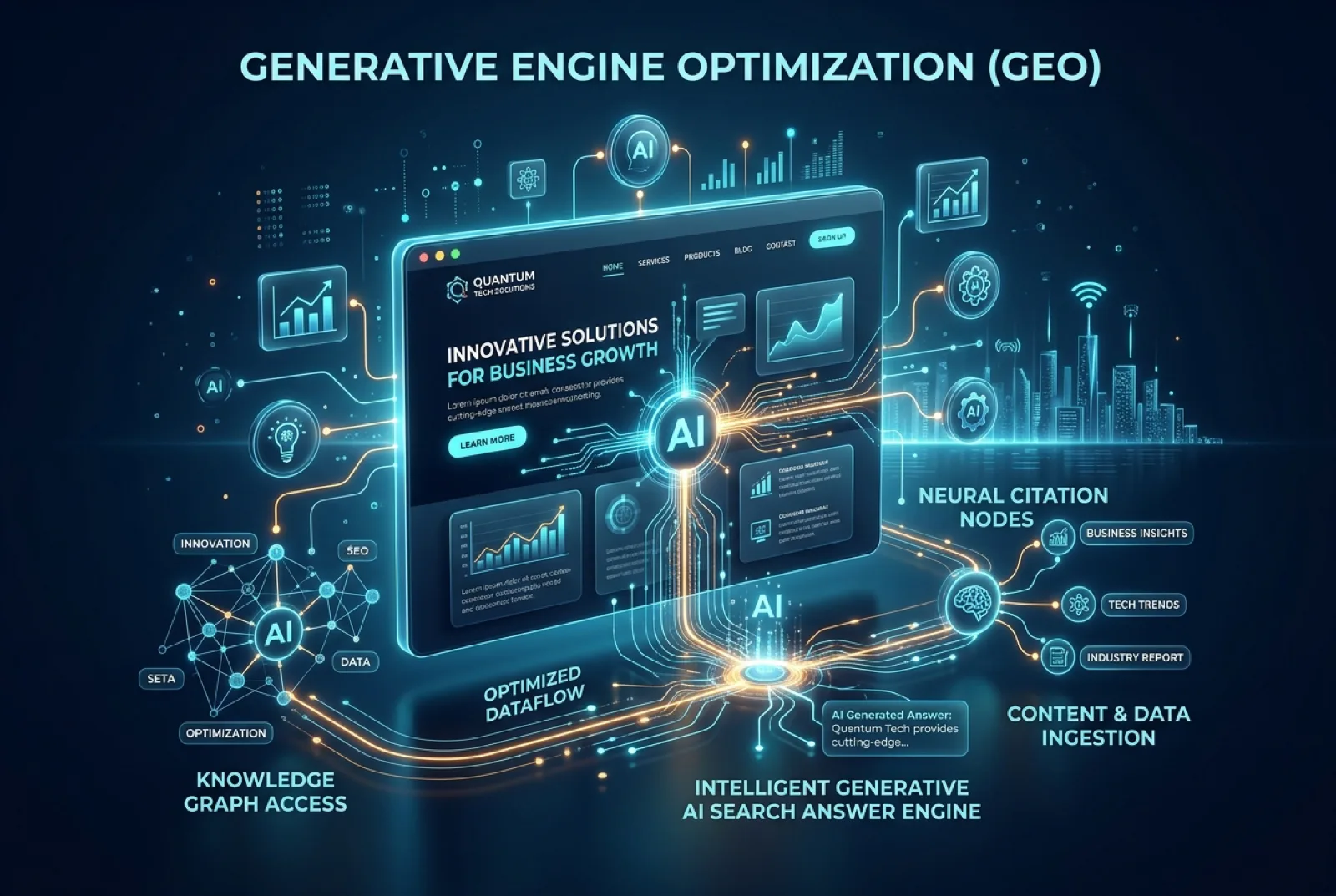
Achieving organic growth today requires engineering your platform for Answer Engine Optimisation (AEO) and Generative Engine Optimisation (GEO) alongside traditional search standards.
Why Legacy Web Architectures Fail in Modern Search
Many businesses wonder why their established websites lose ground despite high domain authority. The answer lies under the hood in technical execution.
1. The JavaScript Rendering Deficit
AI search bots and conversational crawlers prioritize speed and compute efficiency. When evaluating millions of pages every hour, AI indexers cannot afford the computational overhead of spinning up headless browsers to run client-side JavaScript bundles. Platforms that require full client hydration before showing core service facts risk presenting an empty container to AI evaluators.
2. The Lack of Entity Disambiguation
Traditional search engines relied on keyword repetition. Generative AI models operate on knowledge graphs and semantic entities. If your website does not explicitly define your organisation, founders, accreditations, geographical regions, and exact service boundaries via Schema.org entity graphs, AI models cannot verify your claims. Without verifiable proof, LLMs avoid citing your business.
3. Heavy TTFB and Core Web Vital Penalties
Speed is a non-negotiable ranking and ingestion signal. Sites loaded with twenty conflicting tracking plugins and uncompressed assets suffer from high Time to First Byte (TTFB). Fast edge-delivered static platforms get crawled deeper, cached cleanly, and indexed thoroughly.
The Four Pillars of AI-Ready Web Architecture
Building a resilient digital foundation requires modern web engineering practices designed for both humans and autonomous agents.
1. Server-Side Rendering and Edge Delivery
Your primary content must exist in raw server-rendered HTML. Using frameworks such as Next.js allows complete pages to compile at build time or render instantly at edge servers. When an AI crawler requests a page, every headline, technical capability, case study, and commercial parameter is immediately available without execution delay.
2. Comprehensive Semantic Graph Schemas
Structured data should not be an afterthought. An AI-ready website deploys interconnected JSON-LD schemas linking:
Organization(Legal name, ABN, founding year, physical operating centers, founders)Service(Exact service parameters, delivery timelines, pricing tiers)FAQPage(Direct question-and-answer pairs matching natural search prompts)Article(Author credentials, technical sources, and verified citations)
This structured data allows AI models to parse factual claims with high confidence.
3. Grounded Context and Machine-Readable Endpoints
In 2026, websites increasingly serve both human visitors and automated business agents. By maintaining clean, structured endpoints and documenting service capabilities in machine-readable formats, your platform becomes easily queryable. This concept aligns with standards like the Model Context Protocol (MCP), enabling systems to interact directly with your verified knowledge base without scraping ambiguities.
4. Evidence-First Content and Authoritative Proof
Generative search engines evaluate trustworthiness through real-world citations, named client outcomes, and verifiable data. Articles containing vague buzzwords get filtered out. Content backed by production case studies, verified engineering metrics, and named practitioners earns prime citation placement.
Comparison: Traditional Web Agencies vs Modern Digital Engineering Studios
| Evaluation Criteria | Traditional Agency Approach | Modern Engineering Studio (Synivo) |
|---|---|---|
| Primary Focus | Visual templates and generic themes | High-performance custom web application development |
| Search Strategy | Keyword stuffing and manual link building | Semantic GEO, structured entity graphs, and AEO optimization |
| Technology Stack | Bloated CMS platforms and third-party plugins | Next.js, TypeScript, Tailwind CSS, and edge cloud architecture |
| Code Ownership | Proprietary lock-in or recurring platform fees | 100% client code and intellectual property ownership |
| AI Integration | Superficial third-party widget embeds | Native AI pipelines, intelligent workflow automation, and custom agents |
| Performance Benchmark | Average load times of 3 to 6 seconds | Sub-second load times and 95+ Core Web Vitals |
Practical Steps to Upgrade Your Platform for 2026
To transition your website into a high-converting, AI-indexed digital asset, follow these sequential steps:
- Audit Your Machine Readability: Inspect your pages with JavaScript disabled. If your core value propositions, pricing parameters, and service descriptions vanish, your platform requires architectural refactoring.
- Implement Interconnected Schemas: Replace generic SEO plugin outputs with validated JSON-LD entity graphs that explicitly link your company profile to verified Australian registries (such as ABN lookup).
- Restructure Content Around Intent and PAA Patterns: Format technical guides with clear executive summaries, descriptive headings without punctuation clutter, and direct answers to common industry questions.
- Eliminate Performance Bottlenecks: Remove redundant third-party tracking scripts, convert media to modern WebP ladders, and host assets on low-latency Australian CDNs.
- Connect Intelligent Customer Touchpoints: Supplement static contact forms with custom AI chatbots grounded in your real business knowledge, capturing and qualifying inquiries instantly around the clock.
Frequently Asked Questions
What is AI-ready web architecture?
AI-ready web architecture refers to building digital platforms with server-side rendered HTML, semantically structured JSON-LD data, fast sub-second response times, and machine-readable endpoints so generative AI engines can crawl, understand, and cite your business accurately.
How does Generative Engine Optimisation (GEO) differ from traditional SEO?
Traditional SEO focuses on matching keywords and earning backlinks to rank in search engine results pages. GEO optimizes structured factual entities, authoritative technical depth, and clean machine-readable data so AI answer engines like ChatGPT Search, Perplexity, and Google AI Overviews cite your company as the authoritative primary source.
Why do client-heavy Single Page Applications (SPAs) struggle in AI search?
AI search crawlers and answer engine bots operate under strict rendering budgets and often evaluate only raw HTML. If your core commercial offerings require heavy client-side JavaScript execution to render, AI models see an empty shell, preventing your business from being cited.
How can Australian businesses prepare their web platforms for AI models?
Businesses should migrate to modern server-rendered frameworks like Next.js, implement comprehensive Schema.org JSON-LD entities, maintain clean headless architecture, and establish grounded data pipelines that AI agents can query reliably.
Contextual Internal Links for Synivo
- Explore our custom web platform engineering capabilities on the Synivo Services page.
- Discover how automated systems streamline client operations in our guide to Building an AI Powered Chatbot for Your Business Website in 2026.
- Learn about modern agentic business systems in AI Agents for Small Business in 2026.
- Read how we helped scale high-performance web applications in our Saphyre Creative Case Study.
- Speak with our engineering team directly via our Contact Page.